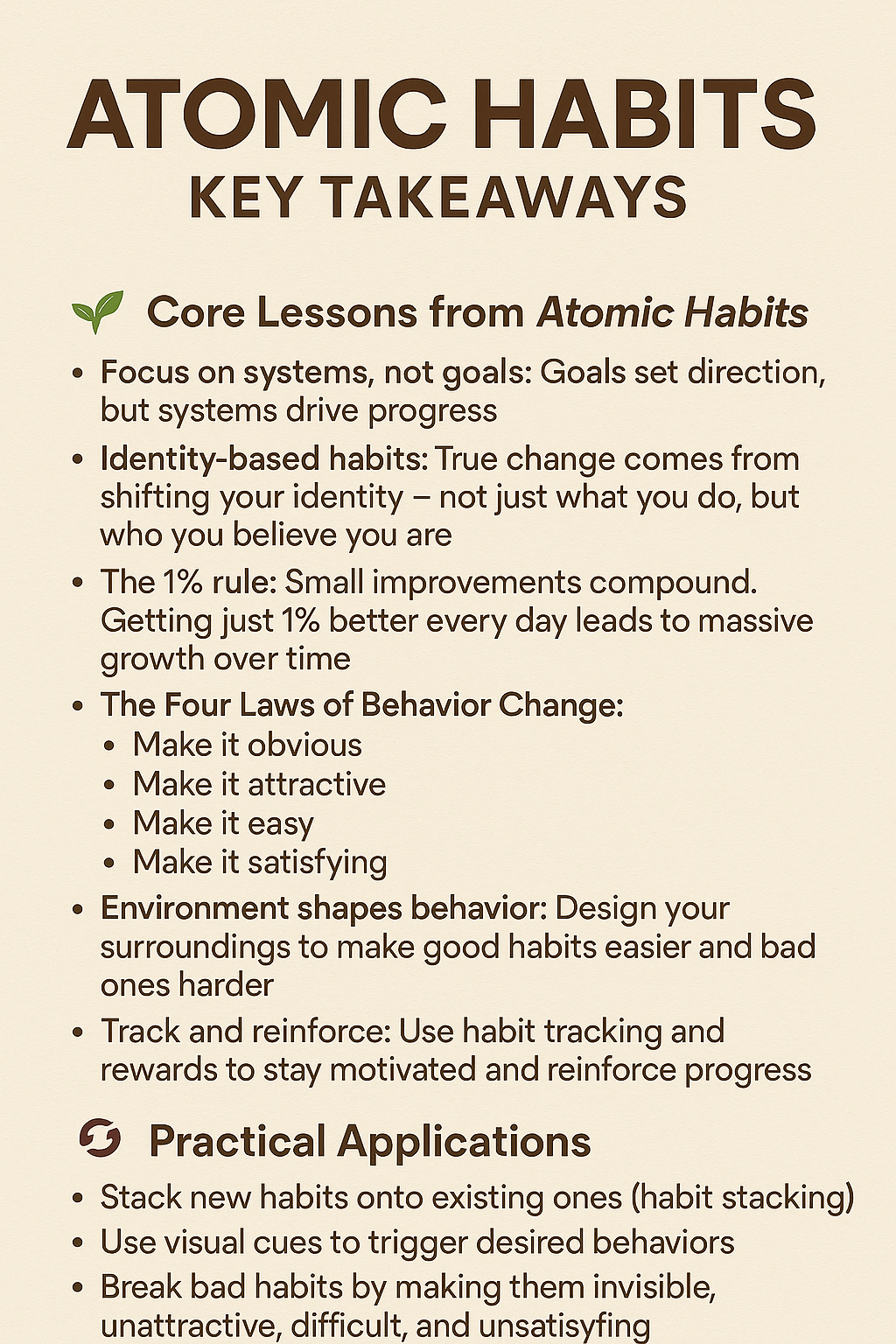
The core message is that success isn’t about monumental shifts, but about mastering the tiny, daily systems that compound over time. (Source: James Clear)
Here are the most important concepts, insights, and takeaways.
1. The Core Philosophy: Systems Over Goals
Clear makes a vital distinction that reshapes how we think about achievement:
Goals are the outcomes you want to achieve.
Systems are the processes that lead to those outcomes.
“We don’t rise to the level of our goals, we fall to the level of our systems.”
Why Systems Win:
Winners and losers have the same goals. Every Olympic athlete wants a gold medal. What separates them is their training system.
Goals can restrict happiness (the “I’ll be happy when…” trap), while falling in love with the system allows you to find joy in the process.
Goals are for people who want to win once. Systems are for people who want to win repeatedly.
Key Takeaway: Stop obsessing over the target. Instead, design and fall in love with the daily habits that will inevitably get you there.
2. The Four Laws of Behavior Change (The Habit Loop)
Every habit runs through a four-stage cycle. To build a good habit, you apply a positive law to each stage. To break a bad habit, you invert it.
Stage of Habit Loop
To BUILD a Good Habit
To BREAK a Bad Habit
1. Cue (The trigger)
Make it Obvious. Increase exposure. (e.g., put your gym clothes next to your bed).
Make it Invisible. Reduce exposure. (e.g., uninstall social media apps).
2. Craving (The motivation)
Make it Attractive. Bundle it with something you enjoy. Ask: “What would this look like if it was fun?”
Make it Unattractive. Highlight the downsides. (e.g., visualize long-term health costs).
3. Response (The action)
Make it Easy. Reduce friction. Use the “Two-Minute Rule”—scale the habit down to two minutes or less.
Make it Difficult. Increase friction. Add steps between you and the behavior.
4. Reward (The benefit)
Make it Satisfying. Use immediate reinforcement (e.g., a habit tracker, moving a paperclip).
Make it Unsatisfying. Add an immediate cost or accountability pact.
The Cardinal Rule:Behaviors that are immediately rewarded get repeated. Behaviors that are immediately punished get avoided.
3. The Master Key: Make It Easy & Master the Art of Starting
The single most important principle for building habits is to make it easy. Most of the battle is won simply by starting.
“The heaviest weight at the gym is the front door.” – Ed Latimore
Practical Tactics for Getting Started:
The Two-Minute Rule: Downscale every new habit. “Read 30 books a year” becomes “read one page.” “Run a marathon” becomes “put on your running shoes.”
Prime Your Environment: Design your space to make good habits the path of least resistance. Put your guitar on a stand, not in the closet. Leave out your journal.
Reduce the Scope, Stick to the Schedule: On bad days, do a tiny version. Doing one push-up is infinitely better than zero. It maintains the identity and the streak.
Habit Shaping: Start with an embarrassingly small step (day 1: bring the vacuum into the room). Gradually build from there.
Key Insight: A habit must be established before it can be improved. Focus on becoming the type of person who shows up consistently, even if in a small way.
4. Identity: The Ultimate Catalyst for Change
The most powerful layer of habit change is at the level of your identity. Every action is a vote for the type of person you want to become.
Outcome-based: “I want to lose weight.” (Focuses on result)
Process-based: “I’m going to start a new diet.” (Focuses on action)
Identity-based:“I am a healthy person.” (Focuses on belief)
“The person who smokes when offered a cigarette might say, ‘No thanks, I’m trying to quit.’ The non-smoker says, ‘No thanks, I don’t smoke.'”
Your habits are how you embody your identity. The goal is not to read a book, but to become a reader. Not to run, but to become a runner.
5. The Power of Community & Environment
You don’t rise above your environment; you adapt to it. Your social and physical spaces act like a form of gravity.
Social Environment: We have a deep need to belong. “The desire to belong often overpowers the desire to improve.”
Action: Join a group where your desired behavior is the normal behavior. You rise together.
Physical Environment: Every space is designed to encourage certain behaviors.
Action: Walk into your main rooms and ask: “What is this space designed to encourage?” Rearrange to make good habits obvious and easy, and bad habits invisible and hard.
6. The 1% Better Every Day Mindset
Improvement is a compounding curve. The effects of your habits are delayed, but magnified over time.
The Math: 1% better each day (1.01^365) = 37x better in a year. 1% worse each day (0.99^365) = almost back to zero.
The Reality: The results are invisible at first. The most important part of the curve is the long, flat beginning where you must trust the process.
The Shift: Focus on your trajectory, not your current position. Ask: “Am I getting 1% better or 1% worse?” If you’re on a good trajectory, all you need is time.
7. Wisdom on Consistency, Failure, & Fun
On Consistency vs. Intensity: People need consistency more than intensity. “Consistency enlarges ability.” The person who trains 20 minutes daily will outlast the person who does a 4-hour workout once a month.
On Failure & Resilience:“The secret to winning is learning how to lose.” Have a plan for getting back on track quickly. Adopt a “next play” mentality like elite athletes.
On Making it Fun: If you’re having fun, you’re dangerous. You’ll persevere when others quit. Author David Epstein told Clear: “Grit is fit.” You display perseverance in areas that are a good fit for you.
On Reflection: The meta-habit above all others is reflection and review. It’s how you troubleshoot your systems and ensure you’re working on the right things. Ask: “Am I creating the conditions for success?”
8. Practical Frameworks & Tools
Habit Stacking: Use an existing habit as a cue for a new one. “After I [current habit], I will [new habit].” (e.g., “After I make my morning coffee, I will meditate for one minute.”).
The Habit Scorecard: Build self-awareness by simply writing down your daily routines and marking them as effective (+), ineffective (-), or neutral (=). Don’t judge, just observe.
Hats, Haircuts, and Tattoos: A decision-making framework. Most decisions are reversible “hats”—move fast. Some are “haircuts”—they last a month, but it’s fine. Very few are permanent “tattoos”—move slowly. We often treat hats like tattoos.
The Four Burners Theory: Life has four burners: Health, Family, Friends, Work. You can’t have all four on high at once. Be intentional about which you turn up or down in different seasons.
Final Quote to Remember
“Time magnifies whatever you feed it. Feed good habits, and time becomes your ally. Feed bad habits, and time becomes your enemy.”
The journey of a thousand miles begins with a single, atomic step. Focus on the system, not the goal. Make it easy, make it attractive, and let your habits cast votes for the person you wish to become.